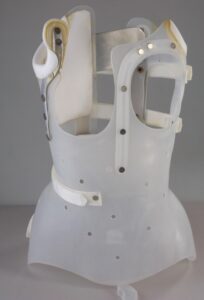
Dynamic Reversible Scoliosis Brace – DDB
The DDB brace is made from a sheet of thermoplastic. It can be divided into three parts: the pelvic section, the superstructure surrounding the abdomen and chest, and the inverted plates.
As a whole, the brace surrounds the upper part of the pelvis, the abdomen, and the chest, with two openings around the chest, one of which corresponds to the concavity of the scoliotic curve and is closed at the top, pressing against the anterior chest wall, while the other is open at the top.
Depending on the case, additional pieces of special foam plastic material (plastazot) are placed at specific points, like pads, in order to achieve greater pressure where necessary, both during manufacture and during treatment. Greater pressure is usually necessary at the points of the hyoid bones, so the plastazot pieces are placed on the two rear halves of the retainer.
The entire construction is reinforced with duralumin metal supports in areas where strong forces are exerted, such as the arches on the anterior chest wall and the vertical opening on the back. Their purpose is mainly to prevent bending or twisting deformations caused by the large forces developed by the action of the reverse presses.
Depending on the case, additional pieces of special foam plastic material (plastazot) are placed at specific points, like pads, in order to achieve greater pressure where necessary, both during manufacture and during treatment. Greater pressure is usually necessary at the points of the hyoid bones, so the plastazot pieces are placed on the two rear halves of the retainer.
The entire construction is reinforced with duralumin metal supports in areas where strong forces are exerted, such as the arches on the anterior chest wall and the vertical opening on the back. Their purpose is mainly to prevent bending or twisting deformations caused by the large forces developed by the action of the reverse presses.
Reverse pressure plates are a characteristic feature of the DDB brace. They are rigid metal pieces made of duralumin, approximately 7 cm high and 15-18 cm wide, depending on the patient’s dimensions. They are approximately 1.5 cm thick. They are attached on one side to the back surface of the brace and to the hemiplegic side corresponding to the hump. When applying the brace, the free end of the pin is placed under the opposite posterior half.
In double scoliosis, there are two pins, one in the thoracic hump and one in the lumbar hump. In some cases, two braces may be placed on the thoracic scoliosis, depending on the extent of the deformity, in which case there may be three braces in a double scoliosis, but no more.
Small holes are cut into the entire surface of the body bag to allow ventilation. The body bag is closed at the back with four horizontal straps, which are attached to the side walls of the body bag and closed with multi-purpose adhesive tape.